
Areas served · Arkansas
Forensic Engineering in Little Rock
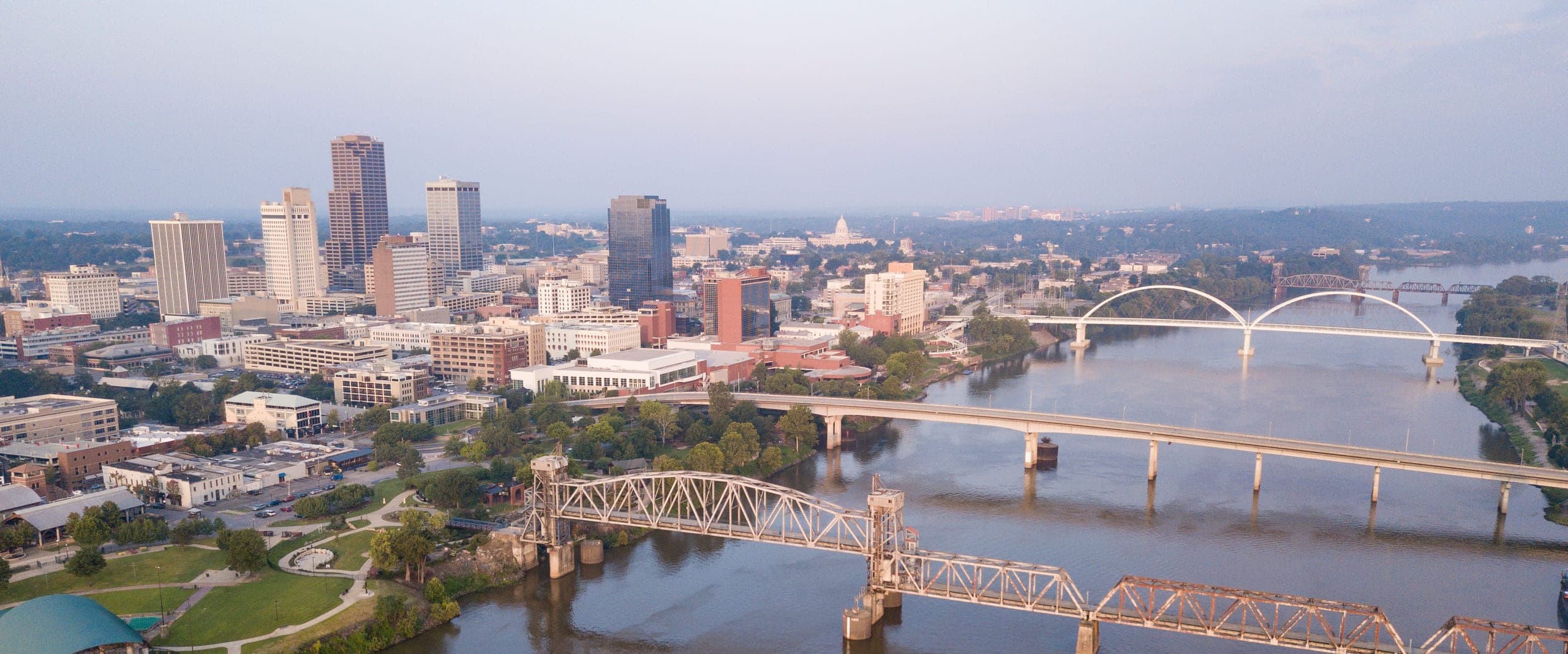
In and around Little Rock
What we investigate in Little Rock
In the Little Rock area, most of the losses we are called to evaluate trace back to two forces: the expansive clay soils that move beneath the foundation and the severe storms and tornadoes that cross central Arkansas each spring. We investigate what actually failed, document it to a standard that holds up, and a licensed engineer responds within 24 hours.
The conditions we see in Little Rock
The Arkansas Geological Survey identifies central Arkansas along the Fall Line as a belt of highly expansive clays, including the Porters Creek Clay, that shrink and swell with moisture. The survey warns that this uneven movement can force concrete foundations to crack and cause houses to "literally break apart." Distinguishing soil-driven movement from a construction defect or a plumbing leak is often the central question in a foundation claim here, and it is one the evidence can answer.
Central Arkansas sits in an active severe-weather corridor. On March 31, 2023, the National Weather Service confirmed an EF3 tornado with peak winds near 165 mph tracked through Little Rock and North Little Rock, damaging hundreds of structures. The region also faces damaging straight-line winds, hail, and periodic Arkansas River flooding, including the May 2019 flood that crested at 29.71 feet at Little Rock and drew federal disaster declarations across seventeen counties.
How we help in Little Rock
The evaluations Little Rock cases usually call for
- Foundation and structural evaluation
We evaluate cracked slabs, distorted framing, and differential settlement to determine whether expansive clay movement, a construction deficiency, drainage, or a plumbing leak drove the damage. We document the evidence, test where warranted, and separate the covered cause from pre-existing conditions.
Our structural engineering services- Storm and water loss investigation
For tornado, straight-line wind, hail, and flood losses, we examine failure points against wind and load paths to distinguish storm damage from wear, prior conditions, and defective construction. We document what the evidence shows and quantify the extent of the storm-caused loss.
Our forensic engineering services
Fire origin & cause
Fire origin and cause in Little Rock
Residential and commercial fires in central Arkansas can hinge on questions of origin, cause, and responsibility long after the flames are out, and the answers live in the physical evidence at the scene. Aging wiring in the historic homes of the Quapaw Quarter and mechanical systems in newer construction alike can be at issue. Early origin-and-cause work matters because scenes are cleaned, altered, or demolished quickly, and evidence not documented promptly is often gone for good.
Our NAFI-certified investigators follow NFPA 921. They work the scene systematically, read the burn and char patterns back to the area of origin, evaluate the electrical and mechanical systems, and eliminate causes until the evidence supports one conclusion, including whether the fire was accidental or incendiary. The investigator who reaches that conclusion documents it, retains the evidence, and testifies to it at deposition and trial.
Fires we investigate
- Residential and commercial fires
- Vehicle fires
- Electrical and appliance fires
- Industrial fires
- Propane and cylinder explosions
Common questions
Forensic engineering in Little Rock, Arkansas
A different question about your case? An engineer, not a call center, answers within 24 hours.
How do you tell expansive clay movement from a construction defect?
We look at crack patterns, elevation surveys, foundation type, drainage, and moisture conditions, and compare them against the soils documented for the site. Central Arkansas clays shrink and swell with moisture, but movement can also trace to grading, drainage, or a plumbing leak. The evidence usually distinguishes them, and we document which one it supports.
Are you licensed to perform engineering work in Arkansas?
Yes. ESI holds an Arkansas firm Certificate of Authorization and our engineers hold individual Arkansas PE licenses, so our evaluations and reports are performed and sealed by a licensed professional engineer.
Do you charge travel to reach Little Rock?
No. Our engineers work Little Rock-area cases from the Omaha lab and Los Angeles office with no travel charges, and a licensed engineer responds within 24 hours.
Have a loss that needs answers?
Tell us what happened. An engineer, not a call center, will review your case.