
Areas served · North Carolina
Forensic Engineering in Durham
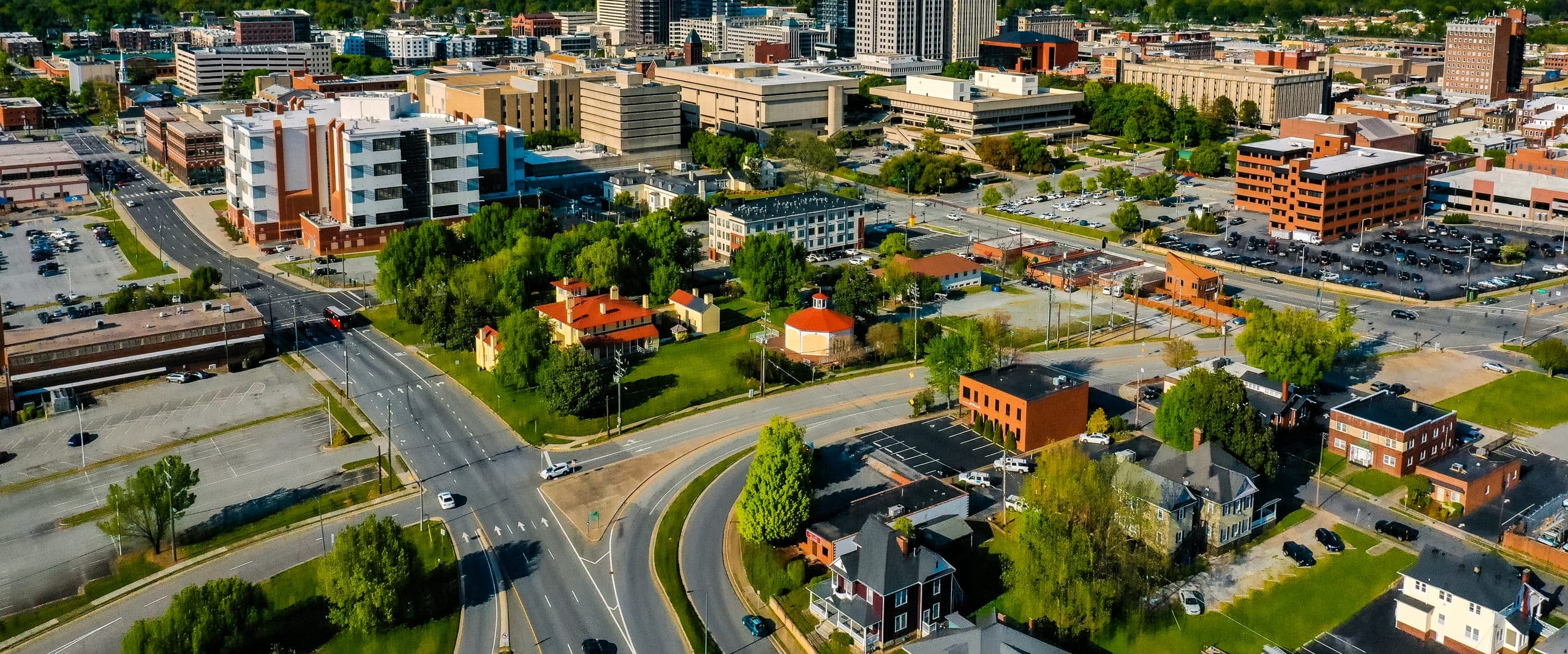
In and around Durham
What we investigate in Durham
Two things drive most of the structural damage we investigate in Durham: a Piedmont subsoil of shrink-swell clay that moves with the seasons, and a downtown of adapted brick tobacco warehouses carrying decades of retrofits. We determine what cracked, settled, or failed and why, and a licensed engineer responds within 24 hours with no travel charges.
The conditions we see in Durham
Durham sits on Piedmont clay soils the North Carolina Geological Survey identifies as shrink-swell, or expansive. They swell when wet and shrink in drought, and that seasonal movement loads foundations, cracks slabs, and racks door and window frames in ways that mimic a construction defect. Piedmont weather also carries the inland reach of Atlantic systems. When Hurricane Fran tracked inland in 1996 it brought damaging wind and heavy rain well past the coast, and the wind and interior water losses that follow such storms are a recurring part of the claims we investigate here.
Durham's building stock reads its own history. The American Tobacco Historic District holds structures dated from 1874 into the 1950s, heavy-timber and masonry warehouses now adapted to offices and residences with layered mechanical and electrical retrofits. East Durham and Trinity Park hold 1900s to 1940s mill houses and Craftsman bungalows with aged wiring and additions, while Research Triangle Park construction is largely post-2000. Separating original construction, later retrofits, storm damage, and clay-driven movement is the engineering question behind most local files.
How we help in Durham
The evaluations Durham cases usually call for
- Expansive-clay and adaptive-reuse evaluation
Cracking and movement in a Durham building can trace to shrink-swell clay under the foundation, to an aging tobacco warehouse or mill structure carrying decades of retrofits, or to a defect. Our licensed engineers evaluate the structure and the soil together and document which one caused the damage.
Our structural engineering services- Storm, water, and construction-defect investigation
We investigate the wind and water losses inland storms leave behind and the construction defects that surface across Durham's mix of century-old and post-2000 stock, then determine whether the cause is the storm, the soil, the original build, or maintenance, based on the physical evidence.
Our forensic engineering services
Fire origin & cause
Fire origin and cause in Durham
Durham's adapted tobacco warehouses and mill buildings pair original heavy-timber and masonry construction with layers of newer mechanical and electrical work, and the older mill houses and bungalows in East Durham and Trinity Park still carry knob-and-tube and patchwork updated wiring. Old construction burns and collapses differently than modern, the retrofits create their own faults, and origin evidence can be lost fast, so reading it correctly is what decides the claim or the case.
Our NAFI-certified investigators apply NFPA 921 through a systematic scene examination, tracing burn and char patterns back to the area of origin and evaluating the electrical and mechanical systems to a defensible accidental or incendiary determination. Bringing an investigator in early preserves the evidence, and the same expert documents the finding and testifies at deposition and trial.
Fires we investigate
- Residential and commercial fires
- Adaptive-reuse and historic-building fires
- Electrical and appliance fires
- Vehicle fires
- Commercial and light-industrial fires
Common questions
Forensic engineering in Durham, North Carolina
A different question about your case? An engineer, not a call center, answers within 24 hours.
Can you tell expansive-clay movement from a construction defect?
Yes. Piedmont shrink-swell clay moves seasonally and cracks foundations in a recognizable pattern, so we evaluate the soil, the drainage, and the damage together before deciding whether clay, the original build, or a defect is responsible.
Do you investigate fires in Durham's converted tobacco and mill buildings?
Yes. Adaptive-reuse structures combine original heavy timber and masonry with layered electrical and mechanical retrofits, and we trace the burn patterns and evaluate those systems to determine origin and cause under NFPA 921.
Do you charge travel to reach Durham?
No. We work Durham-area cases from our Omaha lab and Los Angeles office with no travel charges, and a licensed engineer responds within 24 hours.
Have a loss that needs answers?
Tell us what happened. An engineer, not a call center, will review your case.